
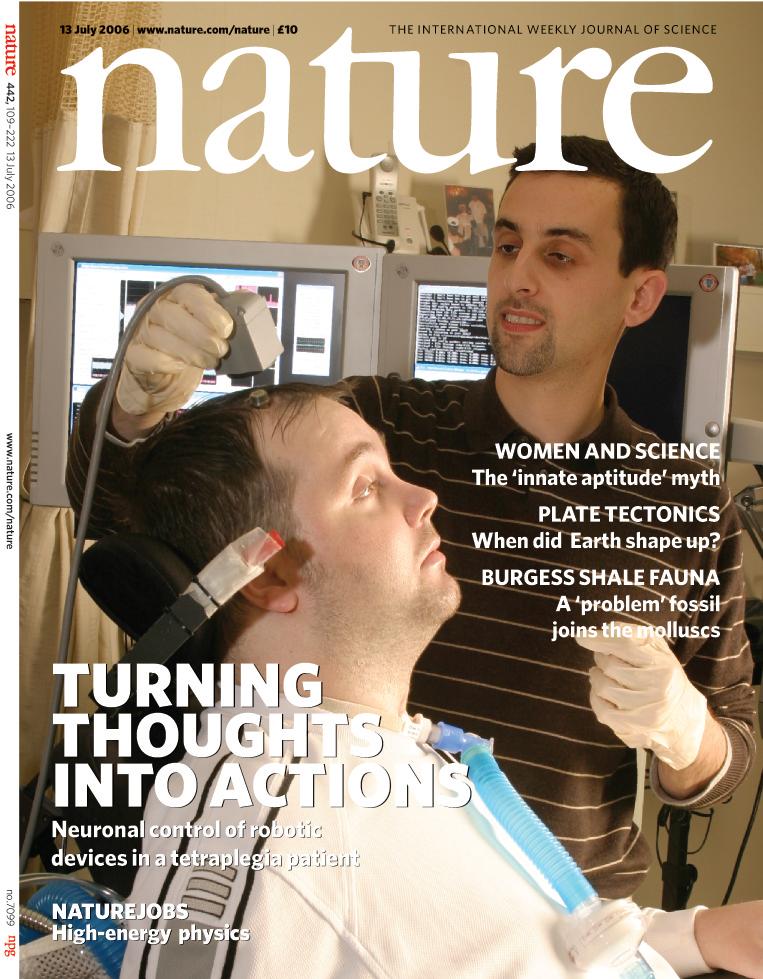
 Scientists have made a breakthrough in their efforts to bring paralysed people the ability to use thought power alone to control artificial limbs, and to interact with computers and other electrical devices.
John Donoghue and colleagues implanted a tiny array of electrodes into the brain of a 25-year-man who is unable to move his arms or legs following a knife wound that severed his spinal cord. The brain implant allowed him to use his thoughts to check emails, play a simple computer game, change channels and volume on a TV, and to control a robotic arm. It is the first time an implant of this kind has been tested in a human.
The electrode array was implanted into the part of the man's brain that, prior to his injury, would have controlled his left arm. By forming the intention to move his arm, neurons were activated in this region, their pattern of firing was recorded by the implant and then an external computer converted the neuronal firing into a command for a mouse cursor or robotic arm.
The findings represent a significant advance on at least three fronts – the man was able to achieve this control within a few minutes of practice; he was able to chat with researchers while he was exerting mental control of the cursor, TV or robot arm; and his control was in all directions, rather than just left and right or up and down. This is in contrast to non-invasive brain-machine interfaces that rely on recording the surface electrical activity of the brain. They require weeks or months of training, demand the user’s full attention when in operation, and, until recently, only allowed one-dimensional cursor control. This new study also shows that several years after paralysis, neurons that were previously involved in controlling limbs still respond to the will to move.
However, significant hurdles remain. As well as involving surgery and the risk of infection, the device used in this trial was connected by wires to bulky computing equipment and required constant fine tuning. A fully-implantable, wireless device would be preferable. Moreover, the precise control we achieve with our natural limbs depends on constant sensory feedback from touch and proprioception – the sense of where our limbs are in space. Scientists have a long way to go before they 'close the loop' by mimicking this kind of feedback.
__________________________________
Hochberg, L.R., Serruya, M.D., Friehs, G.M., Mukand, J.A., Saleh, M., Caplan, A.H., Branner, A., Chen, D., Penn, R.D. & Donoghue, J.P. (2006). Neuronal ensemble control of prosthetic devices by a human with tetraplegia. Nature, 442, 164-171. Open access.
Link to accompanying videos. Open access.
You have read this article Brain /
Technology
with the title
. You can bookmark this page URL https://psychiatryfun.blogspot.com/2006/07/new-dawn-in-brain-machine-interfacing.html. Thanks!


